Should I Be Taking Creatine? An RD Breaks Down What the Research Actually Says

Creatine is having a moment — and if you're a woman, chances are someone has told you it's the thing you've been missing.
So should you be taking it??
My answer: it depends. So here's the full picture, claim by claim — what the research supports, where it's still emerging, and where the science isn't quite where the marketing is yet.
TL;DR
Creatine is safe for most people and one of the most researched supplements out there — but safe doesn't automatically mean worth it for you
It only fuels one of three muscle energy systems — the one powering short, intense efforts like lifting, sprinting, and explosive movement
If your training doesn't heavily tax that system, the performance and muscle benefit is limited
It works like compound interest — a small edge each session that builds into something meaningful over months of consistent training
You've probably seen people say creatine changed their body — what they're usually describing is creatine plus consistent training plus enough protein plus time
Stores take 3–4 weeks to saturate — but the real benefit comes from training consistently with a full tank over months. Give it 8–12 weeks before you evaluate, and track training progress not how you feel
The "every woman needs this for hormones, brain health, and bone health" claims are interesting but at a much earlier evidence stage than the muscle data
If you decide to take it: creatine monohydrate only, five grams daily, no loading phase, give it 8–12 weeks, and look for NSF certified brands.
Here are two I use:
First — is it safe? Yes. It's one of the most researched supplements out there and safe for most people. If you have kidney disease, check with your doctor first.
So the real question is whether it's worth it for you specifically.
To help you answer this we are going to need to pause for a quick science lesson:
How creatine actually works in your muscles
Think of your muscles as having three different fuel tanks — and during a workout your body is constantly shifting between them, like shifting gears in a car, based on how explosive or sustained the effort is.

Tank one is small, powerful, and instant — it powers about ten seconds of maximal effort before it's empty. A heavy squat, a sprint, a jump. This is the tank creatine fills. Supplementing tops it off beyond what diet alone can do — so you have slightly more fuel going in, and research suggests it may also help the tank recharge faster between sets.
Tank two powers efforts lasting from about ten seconds to two minutes — think a hard set of fifteen reps, a rowing interval, or a sustained climb. The burn and shake you feel toward the end of a tough set? That's this tank working. Creatine doesn't fill this one.
Tank three is your long-game engine — oxygen, carbs, fat, sustained effort. Running, cycling, yoga, walking. Creatine doesn't touch this one either.
Here's the thing — all three tanks are always running. Your body never fully switches one off. What changes is which one is doing most of the work. A heavy lifting session shifts heavily into tank one with every set. A long run stays almost entirely in tank three. A Megaformer class cycles between tanks one and two throughout. That's why the type of training you're doing changes everything when it comes to whether creatine is actually useful for you.
Tank one is where creatine is helpful. Whether it's worth it depends entirely on how much your workout actually uses it.
Now that you have a picture of how creatine works, here's what it can and can't do for your training.
The compound interest effect
Your body only adapts to demands placed on it — that's progressive overload, the foundational principle of all strength training. You have to keep making it harder over time or adaptation stops. Creatine gives that process a small but reaI edge:
A little more energy in the tank → slightly more work per session → slightly greater stimulus → slightly more adaptation → slightly more capacity next session → repeat for months.
That extra rep or two seems trivial on any given day. Compounded over six months of consistent training, it adds up to meaningfully more muscle and strength than you'd have had without it. Muscle mass is one of the strongest predictors of functional health as you age — it protects against falls, supports metabolism, and keeps you doing the things you want to do. That's the long game creatine is actually playing.
You've probably seen people say creatine changed their body. It's possible, but definitely not creatine alone — but what they're usually describing is creatine plus consistent progressive training plus enough protein plus time. Without that stimulus, the research shows minimal to no meaningful body composition changes. Creatine is an amplifier. It needs something to amplify.
So is it worth it for you?
If you want a small edge in your training, can trust that tiny wins compound over time, and have the patience to play the long game — go for it. If you're expecting dramatic results, adjust expectations or skip it. From a muscle perspective, evaluating your actual workouts will be the best way to tell if it is worth it for you.
Does your workout qualify?
This is the most important question and the one nobody asks before buying.

One important note regardless of where your workout falls — creatine needs to be taken daily, not just on training days. The benefit builds over weeks and months of consistent use. If you're not ready to commit to that, it's probably not worth starting. This is a long game supplement. Treat it like one.
Feel like Creatine is right for you?
What to actually take and how
Creatine monohydrate only. No need for creatine HCl, ethyl ester, or any other form. Monohydrate has the most research, the best safety data, and is the least expensive. Other forms cost more and offer no proven advantage.
Three to five grams per day. This is the standard maintenance dose. No loading phase necessary — loading fills stores faster but ends up at the same place. It's a shortcut to saturation, not a requirement.
Give it real time. It takes about three to four weeks for muscle stores to fully saturate — but that's just filling the tank. The actual benefit comes from training consistently with a full tank over the months that follow. A realistic timeline is eight to twelve weeks before you'd notice a meaningful difference in your training capacity. What to track: are you progressing — more reps, more weight, better recovery between sets — compared to where you were before? That's the signal that matters. Not how you feel on any given day, and not the scale.
Mix it with anything. Water, coffee, a smoothie, your protein shake. Timing doesn't matter much. Consistency does.
Third party testing matters. The supplement industry is not regulated the same way pharmaceuticals are. What's on the label is not always what's in the bottle. Look for NSF Certified for Sport or Informed Sport certification — these verify purity, potency, and the absence of banned substances.
The two I personally take and trust:
Both are NSF Certified for Sport, both use creatine monohydrate, no fillers.
The "every woman needs this" claims — rated honestly
You've probably seen creatine marketed as the answer to your muscles, hormones, brain, bones, and mood all at once. If someone is selling you that long a list of benefits, that's a sign the marketing has gotten ahead of the science-it's probably worth finding a different source for your health advice. Strong evidence exists for one thing. Everything else is emerging at best.
Here's where the evidence actually stands:
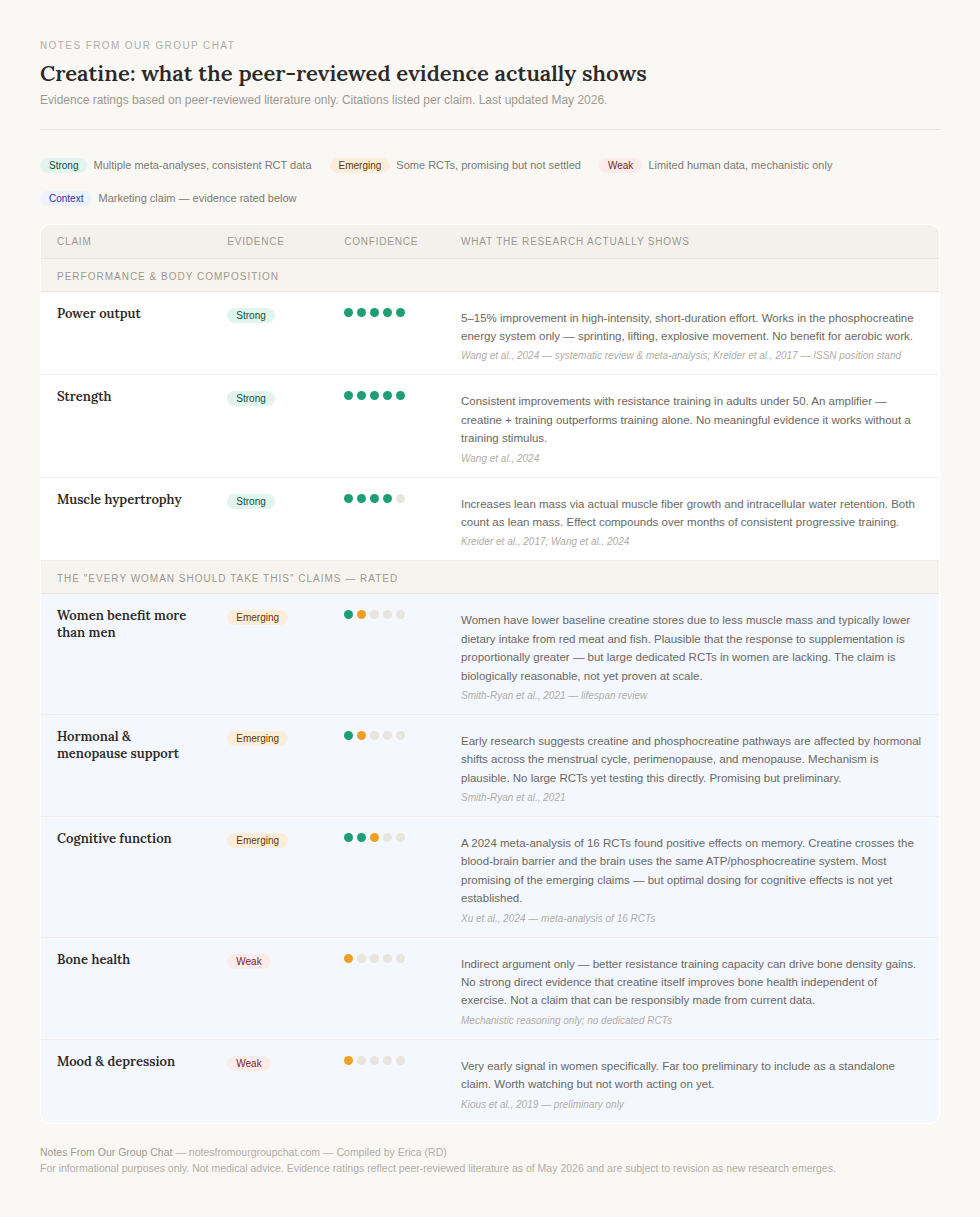
Women may benefit more than men — emerging, plausible Women have lower baseline creatine stores due to less muscle mass and typically lower dietary intake from red meat and fish. A proportionally greater response to supplementation is biologically reasonable and supported by Smith-Ryan et al., 2021 — but large dedicated RCTs in women are still lacking.
Hormonal health and menopause — emerging, preliminary Early research suggests creatine pathways are affected by hormonal shifts across the menstrual cycle, perimenopause, and menopause. Plausible mechanism, no large RCTs yet.
Brain health and cognitive function — emerging, most promising A 2024 meta-analysis of 16 RCTs found positive effects on memory. Creatine crosses the blood-brain barrier and the brain uses the same energy system. The signal is real — optimal dosing just isn't established yet and it is thought that the necessary dose may be higher than what is needed for muscle benefits.
Bone health — weak The argument is indirect. Creatine supports training, and training supports bone density. No strong direct evidence that creatine itself improves bone health independent of exercise.
Mood and depression — very early Small signal in some studies in women. Worth watching, not worth acting on yet.
The honest summary
Creatine is one of the few supplements where the evidence is strong enough that I'd call it genuinely worth considering — for the right person doing the right kind of training.
If you're lifting consistently and progressively, the research applies to you. If you're not, the performance and muscle case is weak regardless of what you're seeing in your feed.
The emerging research on brain health, hormonal transitions, and women's specific physiology is interesting and I'll keep covering it as the evidence develops. I'd rather tell you where things actually stand than sell you on claims that aren't fully there yet.
The question was never is creatine safe. It is. The question is whether it's worth it for your life. And now you have what you need to answer that for yourself.
-Erica MS, RD
This post contains affiliate links, including Amazon and LTK. If you purchase through them, we may earn a small commission at no extra cost to you.
This post is for informational purposes only and does not constitute medical advice. Always consult your healthcare provider before starting any new supplement, especially if you are pregnant, breastfeeding, or have an existing medical condition.
Sources
Kreider RB, Kalman DS, Antonio J, et al. International Society of Sports Nutrition position stand: safety and efficacy of creatine supplementation in exercise, sport, and medicine. Journal of the International Society of Sports Nutrition. 2017;14:18.
Wang R, Zhao H, Li Y, et al. Effects of Creatine Supplementation and Resistance Training on Muscle Strength Gains in Adults <50 Years of Age: A Systematic Review and Meta-Analysis. Nutrients. 2024;16(6):929.
Xu C, Bi S, Zhang W, et al. The effects of creatine supplementation on cognitive function in adults: a systematic review and meta-analysis. Frontiers in Nutrition. 2024;11:1424972.
Smith-Ryan AE, Cabre HE, Eckerson JM, Candow DG. Creatine Supplementation in Women's Health: A Lifespan Perspective. Nutrients. 2021;13(3):877.
Fernandez-Landa J, Fernandez-Lazaro D, Calleja-Gonzalez J, et al. Effects of Creatine Monohydrate on Endurance Performance in a Trained Population: A Systematic Review and Meta-analysis. Journal of Human Kinetics. 2023;86:85-96.
Kious BM, Kondo DG, Renshaw PF. Creatine for the Treatment of Depression. Biomolecules. 2019;9(9):406.


Comments